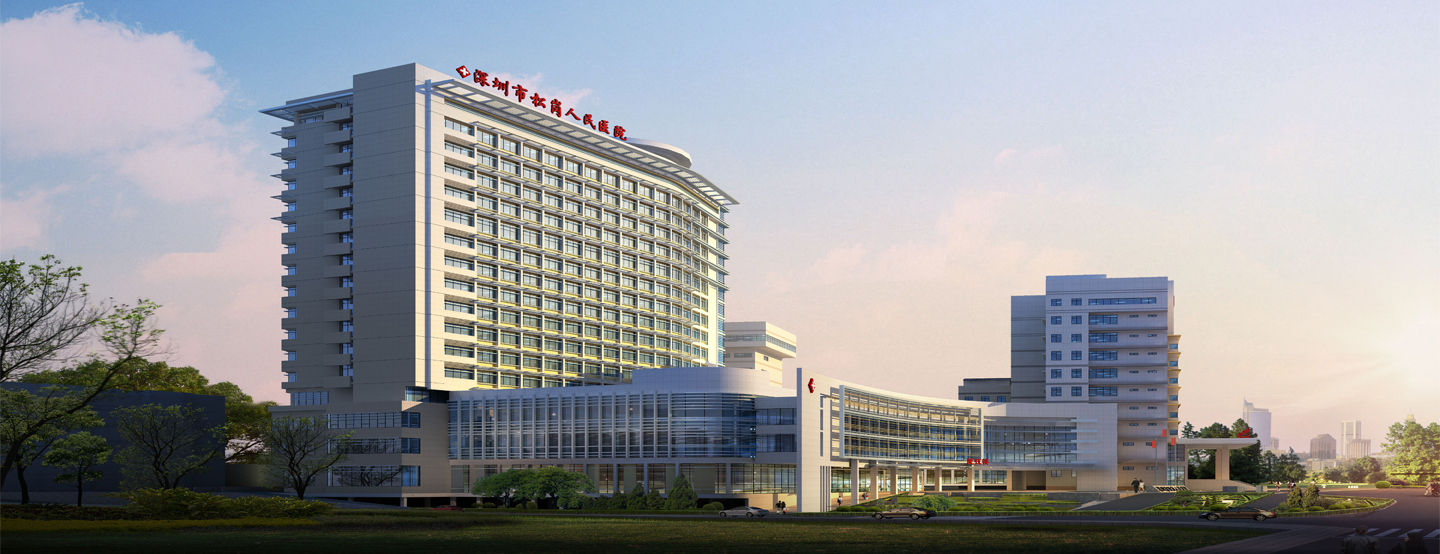
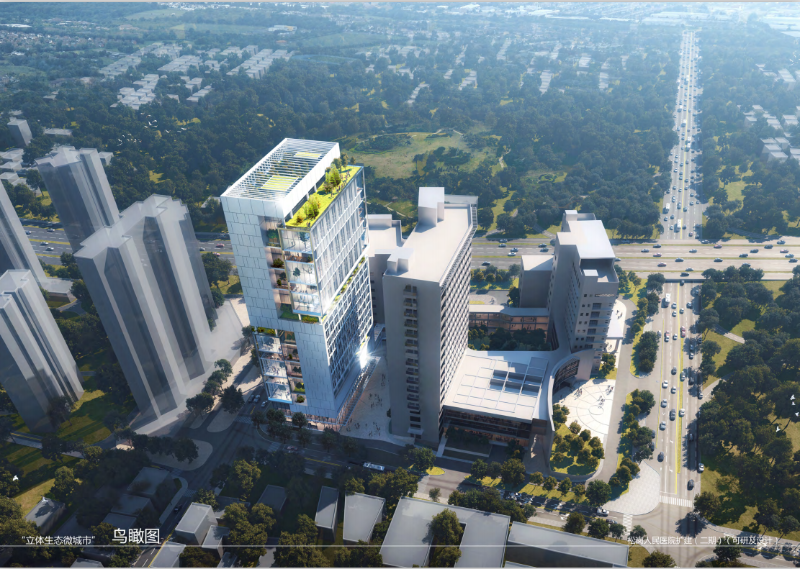
Aerial View of Phase II Planning, Songgang People
Shenzhen Bao'an District Songgang People's Hospital was founded in 1958. Located in the northwest of Shenzhen, it covers a land area of 25,000 square meters with a construction area of 90,000 square meters and 900 authorized hospital beds. After the Phase II expansion completed in 2026, its construction area will reach 144,000 square meters with 1,000 hospital beds. It is currently a National Drug Clinical Trial Institution, co-built Shenzhen Songgang Hospital of Guangdong Pharmaceutical University, Shenzhen Bao'an Clinical Medical College of Guangdong Pharmaceutical University, Shenzhen Postdoctoral Innovation Practice Base, Teaching Hospital of General Institutions of Higher Education in Guangdong Province, Medical Consortium Member Hospital of Sun Yat-sen University Cancer Center, Bao'an Medical Information Innovation Adaptation Pilot Base, National Demonstration Unit for Traditional Chinese Medicine Work in General Hospitals, Shenzhen Branch of the Belt and Road Joint International Laboratory for Mycosis, Member Unit of the National Clinical Research Center for Infectious Diseases, Member Unit of the Chinese Gastrointestinal Oncology Clinical and Translational Research Collaborative Group (GIOC), and Member Unit of National Major Science and Technology Special Projects. As a Grade III general public hospital integrating medical treatment, teaching, scientific research, disease prevention, healthcare, rehabilitation and community health services, it undertakes medical and healthcare services for over one million residents in Songgang, Yanluo Subdistricts and surrounding areas.
The hospital (including community health service sites) has around 1,560 staff members in total, among whom approximately 1,450 are medical and technical personnel, accounting for 93.7%. Around 250 hold master's or doctoral degrees, taking up 16.1%, and about 230 have senior professional titles, accounting for 15.2%.
The hospital is equipped with medical devices including MR, CT, DSA, ultra-high-definition electronic gastrointestinal endoscopes, multi-person hyperbaric oxygen chambers, interventional C-arms, high-end four-dimensional color Doppler ultrasound machines, digital mammography systems and fully automatic biochemistry and immunoassay analyzers. The original total value of its assets is about 470 million RMB, with around 70 sets of equipment each valued at over one million RMB.
The hospital has 49 clinical and medical technology departments capable of carrying out specialized medical technologies for Grade A tertiary hospitals. It boasts 2 district-level key specialties (Digestive Disease Center, Hepatology Dept) and 1 district-level characteristic TCM specialty (TCM Classic Ward). There are 28 community healthcare centers (stations), including 1 national-level demonstration community healthcare center, 4 provincial general practice community training bases, 20 provincial chest pain treatment units, 3 municipal demonstration community healthcare centers and 1 district flagship TCM Clinic.
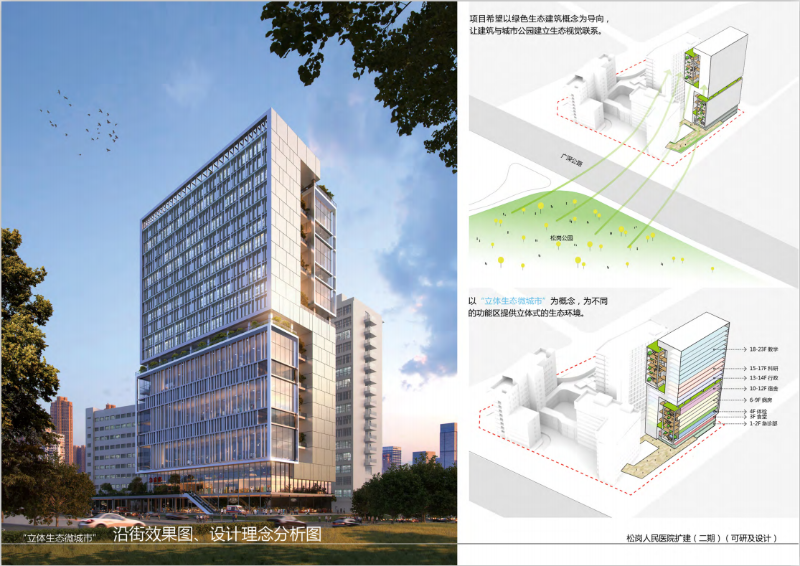
Side Elevation and Functional Structure Diagram of the Hospital
For years, the hospital has actively recruited disciplinary talents, cultivated core specialists, and continuously strengthened discipline development.
The hospital Stroke Center is a National Comprehensive Stroke Prevention and Treatment Center. It has recorded the shortest thrombolysis time for five consecutive years, ranking first in both Guangdong Province and Shenzhen City. It was awarded the Advanced Unit for Continuous Quality Control of Stroke Centers in Guangdong Province in 2023 and designated as a Stroke Center Construction Unit of Tertiary Hospitals in Guangdong Province in 2025. The hospital Chest Pain Center holds national certification and was honored as a Provincial Advanced Unit for Quality Control for two straight years, topping Shenzhen’s quality control assessment in 2024. The hospital successfully passed the acceptance inspection for the Guangdong Provincial Tertiary Trauma Center in the same year.
As a key specialty of Bao’an District, the Digestive Disease Center was among the first institutions certified to perform Grade IV digestive endoscopic surgeries in Guangdong Province. It independently delivers complex difficult procedures including ERCP, TACE and liver cancer conversion therapy. The Department of Gynecology chairs the Gynecology Specialized Committee of the Bao’an Medical Association, with minimally invasive surgical techniques at domestically advanced levels. It independently performs transumbilical single-port laparoscopy and natural orifice transluminal endoscopic surgery (V-NOTES).
A wide range of new medical technologies and procedures have been introduced, steadily elevating the hospital’s capacity for critical emergency care and overall clinical proficiency. The hospital has maintained the highest performance rating for four consecutive years in the latest national performance assessment for Grade II public hospitals.
The hospital has established cooperative ties with Academician Zheng Shusen’s Team from Shulan Medical Group, Academician Liao Wanqing’s Team, Sun Yat-sen University Cancer Center and Guangdong Pharmaceutical University. It has introduced high-level medical teams led by Professor Chong Yutian (Hepatology Department, the Third Affiliated Hospital of Sun Yat-sen University, a high-level medical team of Bao’an District), Professor Chen Qing (Director of Gynecological Oncology, the Second Affiliated Hospital of Sun Yat-sen University), Professor Huang Haiwei (Neurology Specialist, the First Affiliated Hospital of Sun Yat-sen University), Professor Tao Enxiang (Director of Neurology, the Eighth Affiliated Hospital of Sun Yat-sen University) and Professor Yan Fang (Director of TCM Classic Ward, Guangdong Provincial Hospital of Chinese Medicine). Through regular outpatient consultations, ward rounds, surgeries and multidisciplinary remote consultations delivered by renowned academicians and specialists, advanced technologies are introduced and innovated continuously, making premium medical resources more accessible to patients.
Seizing the major historic opportunities brought by the Dual Zone Development Strategy, the hospital follows the "1+4" policy documents issued by Bao’an District to boost high-quality healthcare development. Targeting the establishment of a Grade A tertiary hospital, it prioritizes discipline development, scientific research and teaching, and advances hospital digitalization and refined management. Three integrated platforms have been built for balanced development of specialized and general medicine, coordinated medical education, and translational clinical research. The hospital promotes parallel progress in Party building, administration, clinical services, teaching and research. Committed to building a top-tier medical hub serving western Shenzhen, it comprehensively improves the quality and efficiency of medical care, teaching and research, striving to become a benchmark hospital rooted in western Shenzhen and radiating the Guangdong-Hong Kong-Macao Greater Bay Area.
Hospital Motto: Professional Medical Practice, Dedication, Integrity, Universal Benevolence
Xitou Metro Station: Exit A, walk 200 meters forward