
Cell is one of the most prestigious and influential academic journals in life sciences. Ranked among the world’s top three academic journals alongside Nature and Science, it has an extremely high citation rate and rigorous acceptance standard, and is recognized as an authoritative voice in the scientific community. Many of the most important and cutting‑edge discoveries in life sciences are published in Cell, and publication in this journal represents strong recognition of outstanding research capabilities.
On September 12, 2023, a research team led by Zhu Yuanfang and Chen Xiaoyan from the Maternal‑Fetal Medicine Institute of Shenzhen Bao'an Women's and Children's Hospital, in collaboration with the research group of Li Hanjie from Shenzhen Institute of Advanced Technology, Chinese Academy of Sciences and other institutions, jointly published a paper titled “An immune cell atlas reveals the dynamics of human macrophage specification during prenatal development” in Cell.
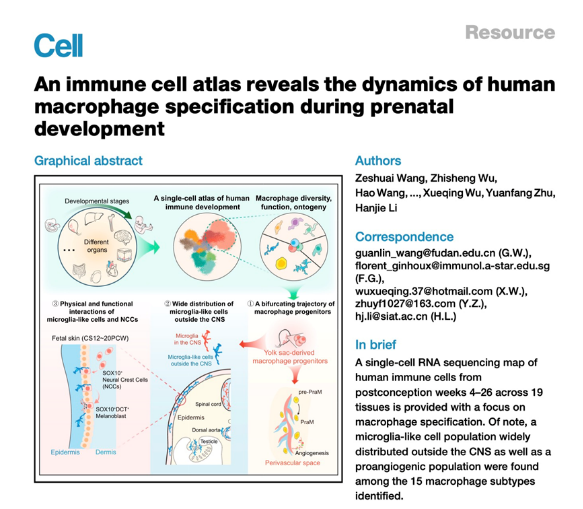
In this study, the research team constructed an atlas of human immune system development and investigated the critical roles of macrophages during development.
Macrophages are essential immune cells widely distributed in various tissues. They can phagocytose and eliminate intracellular parasites, bacteria, tumor cells, as well as senescent and abnormal cells, thereby playing vital roles in immune defense and tissue homeostasis. Macrophages exhibit strong tissue specificity; examples include microglia in the central nervous system and Kupffer cells in the liver.
Fascinated by these unique and indispensable immune cells, researchers at the Maternal‑Fetal Medicine Institute of Shenzhen Bao'an Women's and Children's Hospital explored their emergence and differentiation, aiming to solve unsolved mysteries in physiology.
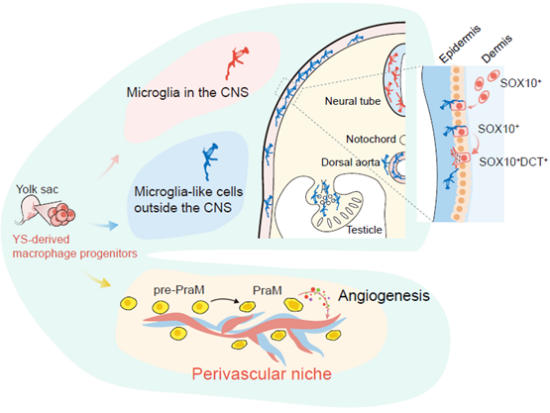
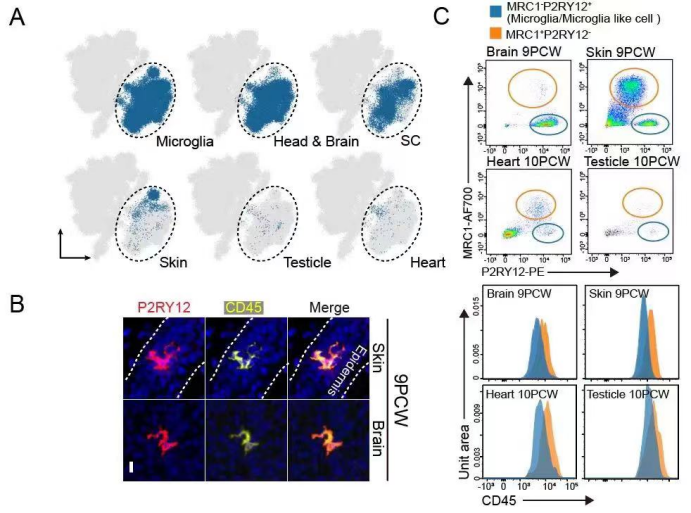
For a long time, microglia were widely regarded as tissue‑resident macrophages uniquely present in the brain and spinal cord. However, the team identified a cell population in multiple peripheral tissues—including epidermis, testis and heart—that highly resembles microglia in morphology and gene expression profiles. These cells were named microglia‑like cells. Notably, microglia‑like cells are unevenly distributed in fetal skin: sparse in the abdomen and limbs, but dense in the back. The team further revealed that these cells participate in the differentiation of neural crest cells into melanocytes. This discovery indicates that cells in peripheral organs may function beyond immune defense and play key roles in embryonic cell differentiation, renewing the understanding of macrophage function and laying a foundation for future research and clinical applications.
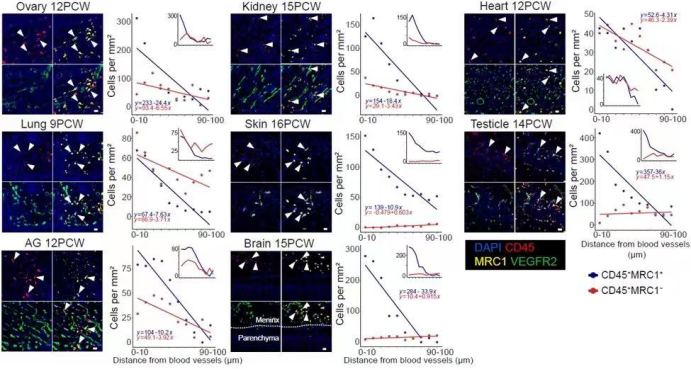
In addition, the researchers identified a specialized macrophage subset characterized by expression of angiogenesis‑promoting genes and preferential localization around blood vessels in fetal tissues. Further experiments confirmed that these cells promote angiogenesis, and they were named angiogenic macrophages. This finding demonstrates the essential role of macrophages in vascular formation during fetal development. Given the key role of blood vessels in tumor growth, uncovering the mechanism of vascular development may provide new strategies for cancer research and treatment. This discovery also advances understanding of immune‑vascular crosstalk and opens new avenues for immunotherapy.
In this research, Dr. Zhu Yuanfang from the Maternal‑Fetal Medicine Institute of our hospital served as co‑corresponding author. Dr. Chen Xiaoyan and Dr. Wang Hao from the same institute were co‑first authors. Dr. Song Zhuo, Dr. Liu Yingyu and Dr. Huilin Wang from the institute also made important contributions to this work.
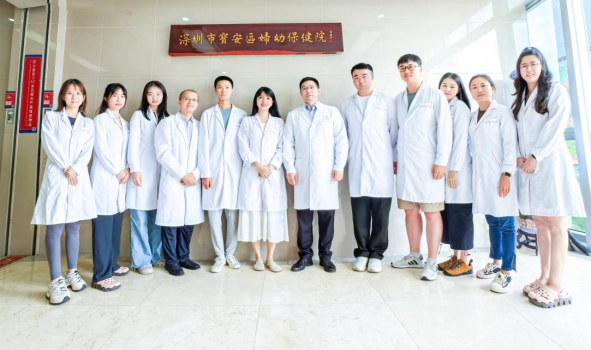
Maternal‑fetal medicine is one of the most important and cutting‑edge fields in medical research. In November 2017, Shenzhen Bao'an Women's and Children's Hospital established the Bao’an Maternal‑Fetal Medicine Institute through deep cooperation with The Chinese University of Hong Kong. The institute promotes the integration of clinical practice and scientific research, strengthens disciplinary competitiveness and research innovation, and improves services for pregnant and parenting populations in western Shenzhen. In the past five years, the institute has been awarded 12 national research grants and published more than 50 SCI papers in maternal‑fetal medicine.

The Maternal‑Fetal Medicine Institute aims to build a clinical research support system and strengthen scientific innovation. Leveraging the hospital’s rich maternal and child clinical resources, the institute focuses on cutting‑edge medical research, addresses key scientific issues in the diagnosis and treatment of severe, common and frequently‑occurring diseases threatening women’s and children’s health, and develops key technologies. Supported by big data and machine learning, the institute is building a patient‑centered research database and disease repository.
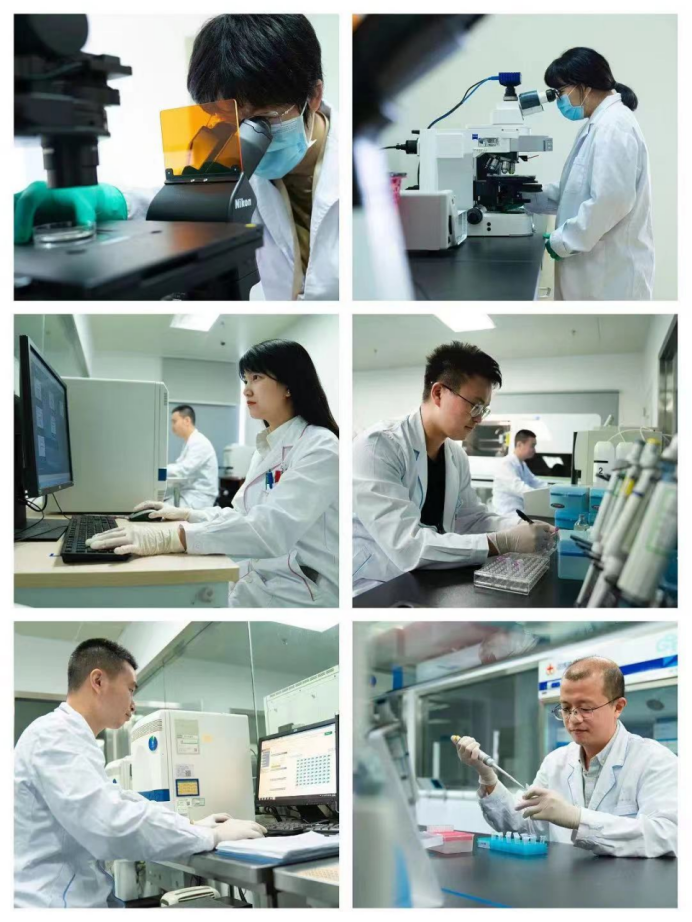
Shenzhen Bao'an Women's and Children's Hospital is a Grade A tertiary maternal and child health hospital integrating medical treatment, health care, rehabilitation, education and scientific research. It is designated as a National Birth Defect Intervention and Rescue Base, National Demonstration Area for High‑Quality Maternal and Child Health Services, National Specialized Center for Preconception Care, Guangdong Provincial Specialized Center for Maternal and Neonatal Health Care, Shenzhen Critical Neonatal Rescue Center, Shenzhen Perinatal and Neonatal Early Intervention Center, Shenzhen Key Medical Specialty (Obstetrics, Neonatology), the first hospital in Shenzhen to establish a human milk bank, Shenzhen Child‑Friendly Hospital, and Bao’an Critical Neonatal and Pregnant Women Rescue Center. The hospital adheres to the whole life cycle and three‑level prevention concepts throughout maternal and child health care, and strives for deep integration of health care and clinical services.
Moving forward, Shenzhen Bao'an Women's and Children's Hospital will continue deep cooperation with The Chinese University of Hong Kong, Shenzhen Institute of Advanced Technology (Chinese Academy of Sciences), Shanghai Children’s Medical Center and other academic institutions. Based on its superior disciplines, the hospital will translate basic medical advances and professional technologies into clinical applications, improve local maternal‑fetal medicine and maternal‑child health services, ensure maternal and infant safety, and provide access to world‑class medical care for women and children in the district.